Congratulations! You just signed the lease on your dream apartment. The natural light is unreal, the view is postcard-worthy, and the rent is somehow within budget. There’s just one small, gravity-defying detail standing between you and paradise: it’s on the top floor, and there is no elevator in sight.
Welcome to the walk-up club. Living on the 4th or 5th floor is an excellent way to build stamina, rack up daily steps, and skip the gym membership guilt. But let’s be honest — while the living part is a joy, the moving in part can feel like a waking nightmare. Stairs are unforgiving, especially when you’re staring up at them with a sleeper sofa or a double-door refrigerator in your arms. Throw a long-distance relocation into the mix, and you’ve got a recipe for total burnout.
If you’re currently losing sleep over how to haul your entire life up all those steps without snapping your back (or your friendships), take a deep breath. You’re in the right place. In this comprehensive guide, we’ll walk you through battle-tested survival tactics for a walk-up move — how to prepare, how to get through moving day if you’re going the DIY route, and, most importantly, why hiring professional long-distance movers and auto transport services is the smartest move you’ll make in 2026.
Trust our expert movers to handle heavy appliances safely during your move. Phase 1: Preparation — If You’re Determined to DIY
If you’ve decided to take on this mountain of stairs alone, your strategy needs to be airtight. Moving into a walk-up requires a completely different mindset than moving into a ground-floor house. Your biggest enemy isn’t distance — it’s weight.
Ruthless Decluttering: Lighter Is Always Better
Rule number one of walk-up life: don’t move what you don’t need. Every single item you pack is an item you’ll have to carry up multiple flights of stairs.
- The one-year rule: if you haven’t worn it, used it, or even looked at it in the past 12 months — donate it, sell it, or toss it.
- Ditch the heavy furniture: do you really need that solid-oak dining table from 1998? Consider selling bulky, outdated pieces before the move and buying lighter, modular replacements once you arrive.
- Digitize what you can: books, DVDs, and stacks of old paperwork are shockingly heavy. Scan, upload, and lighten your load.
Smart Packing: Why Small Boxes Are Your Best Friend
A common amateur mistake is buying the biggest boxes on the shelf and cramming them to the top. When you’re climbing four flights, a massive, overstuffed box is your worst enemy.
The golden rule of weight distribution: heavy items go in small boxes; light items go in big boxes.
- Books and kitchenware should only be packed in small, sturdy boxes. The goal is to carry the box comfortably in front of your chest without straining your lower back.
- Linens, pillows, and clothing are perfect candidates for large boxes. Even when fully packed, they stay relatively light and maneuver cleanly around tight stairwell corners.
Tape and Label Like a Pro
A box that bursts open on the third-floor landing is a disaster you simply do not have time for. Use high-quality packing tape and reinforce the bottom of every single box. Label both the top and the sides clearly so whoever is carrying it knows exactly which room it belongs in — because once they’ve hauled it up to the top floor, nobody wants to walk back down just to ask where the kitchen box goes.
Phase 2: Moving Day — Physical Survival on the Stairs
The big day is here. You’ve got the boxes, a rental truck, and a few absurdly loyal friends who agreed to help in exchange for pizza and beer. Here’s how to survive the physical gauntlet.
Dress for Athletic Success
Moving is a high-intensity workout, and the right gear protects both your safety and your efficiency.
- Footwear: comfortable, closed-toe sneakers with serious grip. Slipping on a stair while holding a microwave is not a story you want to tell.
- Gloves: invest in rubberized grip gloves. Sweaty hands slip, and a solid grip takes a huge amount of strain off your forearms.
- Breathable clothing: you will sweat — no question. Wear moisture-wicking fabrics that let you move freely.
Proper Lifting Mechanics — Save Your Spine
We can’t stress this enough: lift with your knees, not your back. Keep the load as close to your body as possible, squat to pick up the box, keep your back straight, and push up through your heels. And never — ever — twist your spine while holding something heavy. If you need to turn, move your feet.
The “Human Chain” Tactic
If you’ve got the manpower, don’t let one person carry a box from the ground floor all the way to the top. That’s exhausting and wildly inefficient. Instead, set up a human chain (a bucket brigade, essentially):
- One person at the truck, one on the second-floor landing, one on the fourth, and one inside the apartment.
- Boxes get passed up the chain without anyone having to climb the full height of the building.
- Everyone saves their legs, their lungs, and their patience.
Hydration and Strategic Breaks
Treat this like a marathon, not a sprint. Keep a cooler of cold water accessible on the ground floor and inside the new apartment. Take mandatory 5-minute breaks every hour to stretch your legs and catch your breath. Skipping breaks isn’t toughness — it’s the fastest route to an injury.
Phase 3: Why Hiring an Agency Is Actually a Savings
Let’s have a moment of real honesty. Reading about proper lifting technique and human chains sounds great on paper, but executing it in real life is brutal. If on top of that you’re moving long-distance, driving a massive rental truck across the country, and then facing four flights of stairs at the end of it all — you are signing up for a special kind of misery.
Here’s why hiring a professional moving agency is the smartest investment you can make for your health, your home, and your sanity.
Your Health Has No Price Tag
A slipped disc, a pulled hamstring, or a seriously tweaked lower back will cost you far more in medical bills, physical therapy, and missed work than any moving quote ever could. Professional movers are industrial athletes. They have the muscle memory, the stamina, and the physical conditioning to carry heavy loads up stairs all day long — without injuring themselves or your belongings.
The Magic of Professional Equipment
Amateurs rely on willpower; professionals have physics on their side. Moving companies show up with tools you almost certainly don’t own:
- Shoulder dollies and moving straps — redistribute the weight of massive items (washing machines, armoires, refrigerators) across the strongest muscle groups, bypassing the strain on arms and lower back entirely.
- Stair-climbing hand trucks — specialized dollies engineered to glide smoothly up each step, absorbing the shock and weight of heavy appliances.
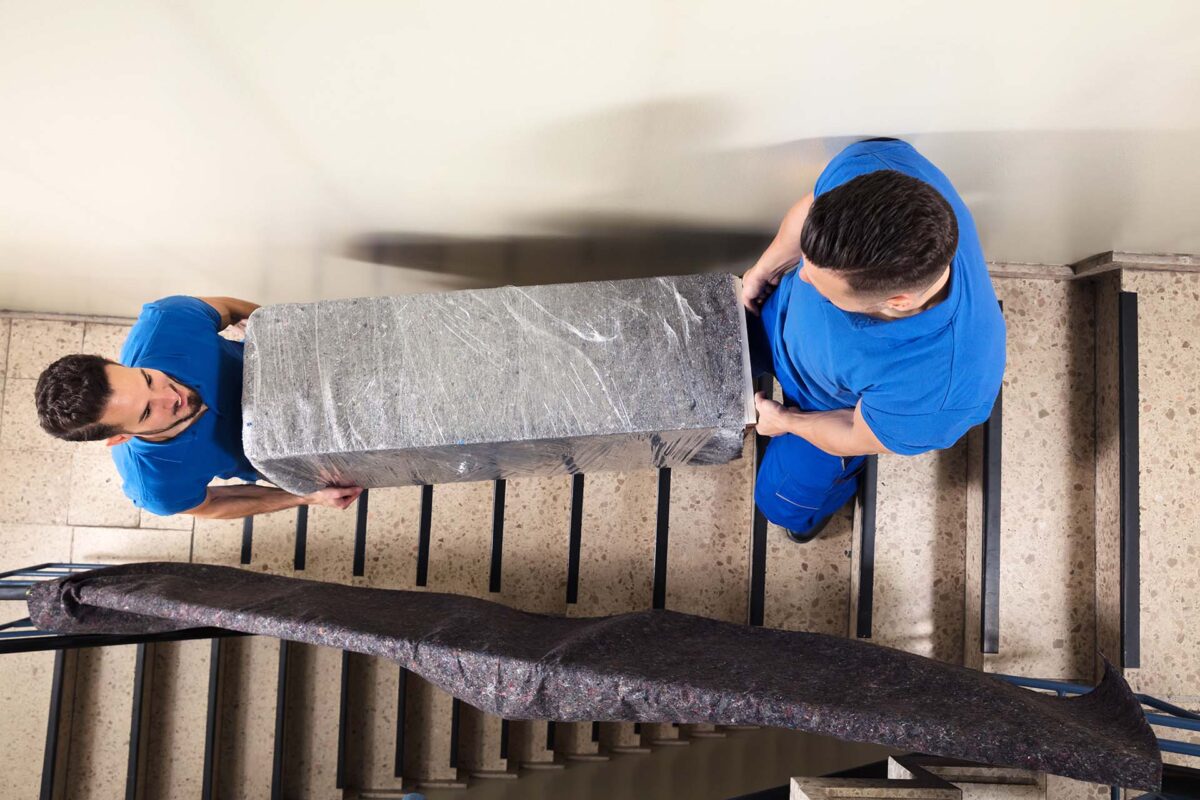
- Thick moving blankets and shrink wrap — keep furniture tightly bound and easy to grip, preventing drawers from flying open halfway up the stairwell.
Lightning-Fast Efficiency
What would take you and four friends an entire Saturday — complete with exhaustion breaks, a steady stream of complaints, and at least one dropped box — a professional crew can finish in a matter of hours. Time is your most valuable asset, especially after a cross-country move. Your first day in a new city should be spent exploring the neighborhood, not collapsed on an unmade mattress.
Enjoying a housewarming beer with friends after a successful move. Protection for Your Stuff (and the Building)
Maneuvering a bulky sofa around tight stairwell corners is a legitimate art form. One wrong pivot and you’ve gouged the drywall of your brand-new building, scratched the handrail, and torn the fabric of your couch. Professional movers know exactly how to angle, tilt, and thread furniture through impossibly tight spaces. And if something does go wrong — reputable agencies are fully insured, so both your belongings and the building’s property are financially protected.
The Long-Distance and Auto Transport Factor
If you’re moving across the country, the logistics get exponentially more complicated. Do you really want to drive a clunky 26-foot truck for three days, tow your car on a trailer behind it, and then haul everything up five flights of stairs at the end?
The modern, stress-free way to move long-distance looks like this:
- Hire long-distance movers to pack, load, transport, and carry everything up the stairs for you.
- Use a professional auto transport service and save thousands of miles of wear and tear on your vehicle (plus the nerves of driving a convoy). Your car arrives safely, professionally transported, and fully insured.
- You fly — quick, comfortable, well-rested — and simply pick up the keys in your new city. Your furniture and your car are already waiting at the door.
This combined, door-to-door approach is exactly what the team at CrossCountry Moving Company specializes in — one call, one quote, one team handling both the household move and the auto transport, coast to coast.
The Bottom Line: Save Your Friends, Save Your Back
A DIY walk-up move is the ultimate test of human endurance — and, frankly, a serious test of your friendships. While it’s technically possible to pull it off with small boxes, quality gloves, and a human chain, the physical and mental cost rarely justifies the savings.
Once you add up the truck rental, fuel, pizza, potential property damage, and the very real risk of a physical injury, investing in a professional team becomes the obvious choice. Your new top-floor apartment is meant to be a sanctuary — start your life there with energy and excitement, not with a heating pad and a bottle of ibuprofen.
Save your friends for the housewarming party, and leave the heavy lifting to the people who do it for a living.
Ready to make your move completely effortless? Request a free, no-obligation quote for your long-distance move and auto transport today. Let the professionals handle the stairs, the highway, and the heavy lifting — so you can focus on enjoying the view from the top.
FAQ
Do moving companies charge extra for stairs?
Yes, most moving companies add a stair fee (sometimes called a flight charge) for walk-up buildings, usually kicking in after the first flight. With reputable agencies, this fee is clearly itemized in your quote upfront — no hidden surprises. Given the physical labor involved, it’s a small price to pay to protect your back.
How far in advance should I book my long-distance move and auto transport?
In 2026, the moving industry is running at full speed. For long-distance relocations, the recommendation is to book your movers and auto transport service 4 to 6 weeks in advance — and even earlier if you’re moving during the peak summer months.
Can I pack my car full of boxes if I use an auto transport service?
Auto transport carriers strictly regulate what can be left in the vehicle due to weight limits and insurance liability. Some allow up to 100 lbs of personal items locked in the trunk, but the safer approach is to let your household movers transport your boxes — that way everything is properly weighed, documented, and covered under their insurance.
What if a piece of furniture physically won't fit up the stairs?
Professional movers are experts in spatial geometry. They’ll often disassemble furniture down to its frame to squeeze it through a tight stairwell. If an item genuinely cannot fit (think: a massive one-piece sectional), serious agencies offer hoisting services through a window or balcony — the piece is securely strapped and lifted from the outside using proper rigging equipment.
How do I prepare my walk-up building for the movers?
Communication is everything. Notify your landlord or building management about the exact date and time of your move. Prop the main doors open securely so movers aren’t fumbling for handles with full arms, and clear the stairwells of any tripping hazards — doormats, plants, bicycles, loose rugs. A clear path saves time, prevents accidents, and keeps everyone happier.